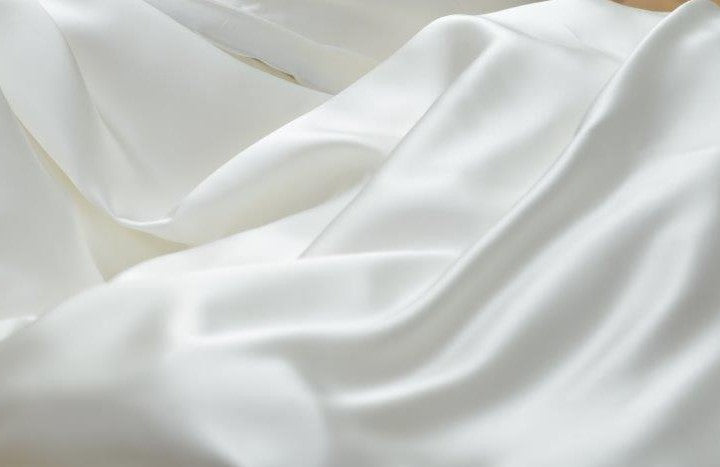


Silk is used in the bedroom in various ways: as a filling for duvets and as a fabric for bed linen and pillowcases. The respective advantages therefore differ depending on where and how the silk is used.
The short answer: Silk is a lightweight natural fiber, can absorb and release moisture, and has an especially smooth surface as a fabric. As a duvet filling, it allows for light, supple blankets with various filling weights. As bed linen or a pillowcase, silk offers a smooth and pleasant feel against the skin.
What are the properties of silk?
Silk is a natural protein fiber. For bedding, the following properties are particularly interesting:
- fine and smooth fiber structure
- low weight
- absorption and release of moisture
- pleasant feel against the skin
- low mechanical friction with smooth silk fabrics
The extent to which these properties manifest in the finished product depends, among other things, on the type of silk, the processing, the weave, the fabric weight, and—in the case of duvets—the filling quantity used.
What are the advantages of a silk duvet?
In a silk duvet, silk is used as the filling material. The filling can be constructed from many thin layers of silk that are pulled apart over a large area and layered on top of one another.
This allows for the production of light and supple duvets with various filling weights. Depending on the amount of silk filling, different versions are suitable for different seasons and warmth requirements.
We explain how a duvet is made from individual silk layers in our guide "How is a silk duvet made?".
How much moisture can silk absorb?
Under appropriate conditions, silk can absorb about 30% of its own weight in moisture. The fiber can absorb moisture and subsequently release it back into the environment.
This property is interesting for bedding because the human body continuously releases moisture into its surroundings during sleep.
However, the actual sleeping climate is not determined solely by the silk fiber. The duvet's outer cover, the bed linen, the filling quantity, as well as room temperature and humidity also play a role.
High moisture absorption therefore does not mean that a silk duvet generally prevents one from sweating at night.
Is a silk duvet temperature-regulating?
Silk is frequently used for bedding due to its heat and moisture behavior. However, whether a specific duvet feels lighter or warmer does not depend on the material alone.
Important factors are:
- Filling weight of the silk
- Construction of the duvet
- Material of the outer cover
- Room temperature
- Personal perception of warmth
This is why there are light silk duvets for summer as well as more heavily filled all-season and winter duvets.
We explain which version matches which warmth need in our guide "Which silk duvet is the right one?".
Is a silk duvet suitable for summer?
Yes. Silk is also suitable for light summer duvets. The filling quantity is particularly decisive here.
A summer duvet contains less silk filling than an all-season or winter duvet. This allows for the production of a light duvet without completely forgoing a textile filling.
When comparing different silk duvets, you should therefore pay attention not only to the label "silk" but also to the specific filling weight.
Is a silk duvet also suitable for winter?
Yes. Warmer duvets can also be filled with silk. For this, a correspondingly larger amount of silk filling is used.
Whether a winter duvet is sufficiently warm for a specific person also depends on room temperature and individual warmth perception.
You can find our different versions under silk-filled duvets.
What are the advantages of silk bed linen?
With silk bed linen, the bed cover itself is made of silk fabric. Unlike with a silk duvet, the silk here comes into direct contact with the skin.
A significant advantage is the very smooth surface. Silk fabric glides easily over the skin and feels soft and supple.
Here too, the silk fiber's ability to absorb and release moisture can contribute to the feel of the material.
You can find our different colors and sizes under silk bed linen made from mulberry silk.
Why does silk feel so smooth?
Silk filaments have a fine structure and can be processed into very smooth fabric surfaces. For bed linen, silk is often processed in a satin weave, which creates an especially smooth surface.
A smooth fabric surface creates less mechanical friction than a coarser surface.
However, how a silk fabric actually feels does not depend solely on the fiber. The weave, fabric weight, and processing also influence its properties.
What are the benefits of a silk pillowcase for hair?
The smooth surface of a silk pillowcase can reduce the mechanical friction between hair and pillow during sleep.
This is particularly relevant for a product that hair lies on for several hours each night and moves across repeatedly due to tossing and turning in one's sleep.
However, this does not mean that a silk pillowcase generally prevents hair breakage or frizz. The reduced mechanical friction is simply a material property of the smooth surface.
You can learn more about this in our guide "Is a silk pillowcase good for the hair?".
You can find our selection under silk pillowcases made from mulberry silk.
What are the benefits of silk for the skin?
With silk bed linen and silk pillowcases, it is primarily the smooth surface that lies directly against the skin. This creates comparatively little mechanical friction between the fabric and the skin.
Many people find this smooth surface pleasant. However, no general medical effects should be derived from this. Silk bed linen is not a medical product and does not treat skin conditions.
Is mulberry silk better than wild silk?
Mulberry silk and Tussah (wild) silk differ in their fiber structure, among other things, and are therefore used for different applications.
Mulberry silk has fine and relatively uniform fibers and is particularly well-suited for smooth silk fabrics. Tussah silk has a different fiber structure and can also be effectively used as a filling material for certain bedding.
A blanket classification into "better" and "worse" therefore does not do justice to the different areas of application.
We explain the differences in detail in the guide "Mulberry silk or wild silk? Differences and usage explained".
Does more momme mean better silk?
No. Momme first describes the weight of a silk fabric and not its overall quality.
A fabric with 22 or 25 momme is heavier than a comparable fabric with 19 momme. However, it does not automatically follow that it is higher quality.
For the quality of a silk fabric, raw silk quality, uniformity of the yarns, weaving, dyeing, and processing also play a role.
We explain what momme, 6A, and quality standards actually mean in the guide "What does momme mean for silk? Quality, 6A, and standards explained".
Does silk also have disadvantages?
Yes. The special material properties of silk also come with some practical disadvantages.
High-quality silk products are generally more expensive than comparable products made from many conventional fibers. Furthermore, silk fabric requires more gentle care.
High washing temperatures, unsuitable detergents, strong mechanical stress, and high heat during drying should be avoided.
You can find detailed instructions in the guide "Washing and caring for silk correctly".
Silk duvet, silk bed linen, or silk pillowcase – what is the difference?
When choosing, it is crucial where the silk is used in the product:
- Silk duvet: Silk is used as the filling material. The outer cover can also consist of cotton satin, lyocell, or another material.
- Silk bed linen: The bed cover itself is made of silk fabric.
- Silk pillowcase: The pillowcase is made of silk fabric and lies directly against the skin and hair.
Anyone primarily seeking a smooth surface against their skin and hair should therefore pay attention to the material of the bed cover or pillowcase. Anyone looking for a light duvet with a silk filling, on the other hand, should compare the filling material and filling weight in particular.
Conclusion: What advantages does silk offer in the bedroom?
Silk can fulfill different functions in bedding. As a duvet filling, it allows for light and supple duvets with various filling weights. As a fabric for bed linen and pillowcases, it offers an especially smooth surface with low mechanical friction.
Added to this is the silk fiber's ability to absorb and release moisture. Under appropriate conditions, silk can absorb about 30% of its own weight in moisture.
Which of these properties is particularly important depends on whether you are looking for a silk duvet, silk bed linen, or a silk pillowcase.
Frequently asked questions about the benefits of silk
What is the biggest advantage of a silk duvet?
Silk fillings allow for light and supple duvets. Through different filling quantities, summer, all-season, and winter duvets can be produced for various warmth requirements.
How much moisture can silk absorb?
Under appropriate conditions, silk can absorb about 30% of its own weight in moisture. The exact moisture absorption depends on the ambient conditions.
Does one sweat less under a silk duvet?
Silk can absorb and release moisture. However, whether someone sweats at night also depends on the filling quantity, bed linen, room temperature, humidity, and personal warmth perception. A silk duvet therefore does not fundamentally prevent sweating.
Is silk good for hair?
The smooth surface of a silk pillowcase can reduce mechanical friction on the hair during sleep. However, it does not fundamentally prevent hair breakage or frizz.
Is silk good for sensitive skin?
Silk fabric has a very smooth surface with low mechanical friction and is therefore perceived as pleasant on the skin by many people. However, no general medical effect can be derived from this.
Is silk better for summer or winter?
Silk duvets can be produced for both seasons. The filling quantity is particularly decisive: summer duvets are filled more lightly, winter duvets more heavily.