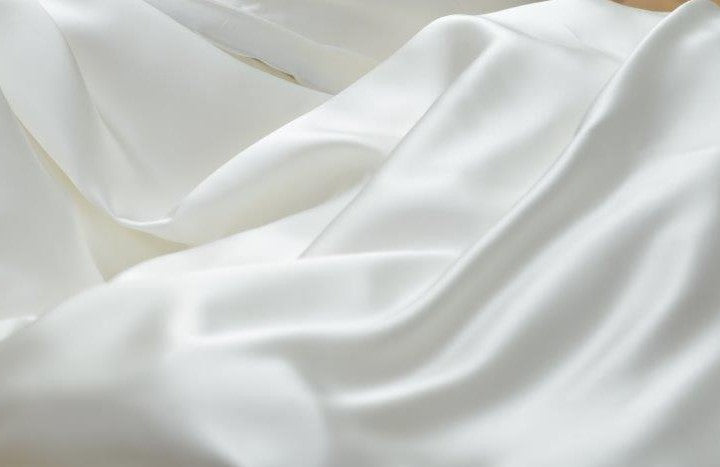


A silk pillowcase is often recommended for hair care. The most important difference compared to many other cover fabrics is the particularly smooth surface of silk.
The short answer: Yes, a silk pillowcase can be pleasant for your hair because its smooth surface generates less mechanical friction during sleep. This can be especially advantageous for long, curly, dry, or delicate hair. However, a silk pillowcase does not fundamentally prevent hair breakage or frizz.
Why can a silk pillowcase be good for hair?
During sleep, your head and hair move across the pillow repeatedly. This creates friction between the hair and the pillowcase.
Silk fabrics have a very smooth surface. This allows hair to glide over the cover more easily and reduces the mechanical stress placed on it while moving at night.
The potential benefit of a silk pillowcase is therefore primarily due to the reduced friction on the hair surface – not a medical or cosmetic treatment of the hair.
Can a silk pillowcase prevent hair breakage?
No, a silk pillowcase cannot completely prevent hair breakage. Hair breakage can have many causes, such as chemical treatments, heat, mechanical stress, or an individual's hair structure.
However, a smooth pillow surface can reduce mechanical friction during sleep. Especially for delicate or already damaged hair, this can be a sensible part of a gentle hair care routine.
Does a silk pillowcase help against frizz?
Again, one should not promise too much. Frizz depends on factors including hair structure, humidity, hair care, and styling.
Since hair is exposed to less friction on a smooth silk surface, it may appear less mechanically roughened in the morning. However, a silk pillowcase is not a remedy that fundamentally prevents frizz.
Which hair types is a silk pillowcase suitable for?
Basically, any hair type can sleep on a silk pillowcase. However, the smooth surface is particularly interesting for people with:
- long hair,
- curly or wavy hair,
- dry hair,
- fine or delicate hair,
- colored or chemically treated hair.
The decisive factor here is not that silk "treats" the respective hair type, but that the surface of the pillowcase is as smooth as possible, thereby creating little mechanical friction.
Silk or cotton – which is better for hair?
Cotton and silk are both suitable as materials for pillowcases, but they possess different surface and care properties.
A smooth silk fabric generally creates less mechanical friction on the hair. Cotton, on the other hand, is robust, versatile, and usually easier to care for.
We explain the important differences in surface, care, and usage in detail in our guide "Silk or cotton – which pillowcase is better?".
Why is mulberry silk used for pillowcases?
Mulberry silk possesses fine and relatively uniform filaments, making it particularly well-suited for smooth silk fabrics.
With a pillowcase, the quality of the finished fabric is paramount: in addition to the silk used, the weave, fabric weight, and workmanship play an important role.
Our mulberry silk pillowcases are designed for direct contact with skin and hair.
What does momme mean for a silk pillowcase?
Momme is a traditional unit for the weight of silk fabric. A higher momme count means that more silk material was used in a comparable area of fabric.
However, more momme does not automatically mean better silk. The quality of a silk pillowcase also depends on the silk fiber, the uniformity of the weave, the workmanship, and other quality features.
We explain the differences between 19, 22, and 25 momme, as well as the meaning of 6A, in our guide "What does momme mean for silk? Quality, 6A, and standards explained".
Is satin the same as silk?
No. Silk refers to a fiber; satin refers to a weave. A satin pillowcase does not, therefore, have to be made of silk. Satin can also be produced from synthetic fibers, for example.
Anyone looking for a pillowcase made of genuine silk should therefore pay attention to the material specification. Terms like "100% silk" or "100% mulberry silk" provide information about the fiber material used.
How do you care for a silk pillowcase?
Silk pillowcases should be washed gently according to the care label. For many silk products, a silk or delicate cycle at a low temperature, along with a suitable silk detergent, is appropriate.
You can find detailed instructions in our guide "Washing and caring for silk properly".
Conclusion: Is a silk pillowcase worth it for your hair?
A silk pillowcase can be a sensible choice if a particularly smooth sleeping surface is desired. Its primary benefit for hair is that the smooth silk surface can reduce mechanical friction during sleep.
It does not fundamentally prevent hair breakage or frizz, but it can contribute to a gentler sleeping surface, especially for long, curly, dry, or delicate hair.
You can find various sizes and colors in our collection mulberry silk pillowcases.
Frequently asked questions about silk pillowcases and hair
Is a silk pillowcase good for curly hair?
The smooth surface can be pleasant for curly hair because less mechanical friction is created when moving on the pillow. However, it does not fundamentally change the natural hair structure.
Does a silk pillowcase help with long hair?
With long hair, a lot of contact between hair and pillow occurs during sleep. A smooth silk surface can reduce the friction generated during this time.
Does a silk pillowcase prevent split ends?
No. Split ends can have various causes and cannot be reliably prevented by a pillowcase. A smooth surface can only reduce the mechanical stress on the hair during sleep.
How much momme should a silk pillowcase have?
19 momme is a frequently used fabric weight for high-quality silk pillowcases and offers a balanced ratio between fabric weight and suppleness. A higher momme count is not automatically a sign of better quality.
Is a satin pillowcase just as good as a silk pillowcase?
Satin only describes the weave and says nothing about the fiber used. A satin pillowcase can be made of silk, but also of other materials. Therefore, the material composition should always be considered for a direct comparison.