

Hair ties come into contact with hair every day. Their surface, elasticity, and construction can influence how much mechanical stress the hair is subjected to when putting it up and taking it down.
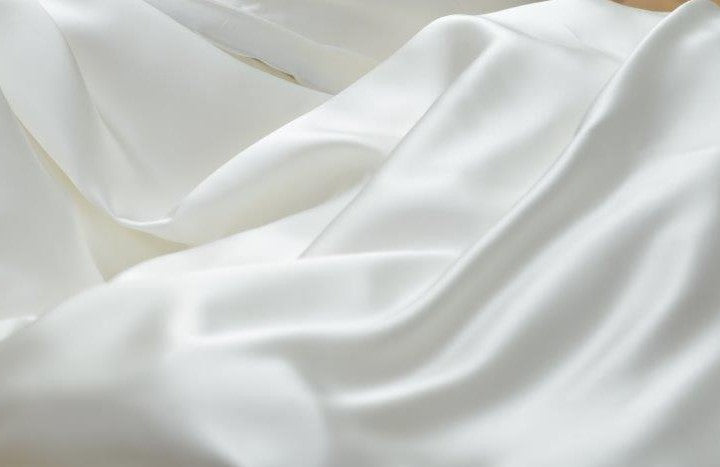
The short answer: Silk hair ties have an especially smooth surface. As a result, less mechanical friction can occur between the fabric and the hair when putting it up and taking it down compared to many rougher materials.
Why is silk particularly gentle on hair?
The smooth surface of silk creates comparatively little friction when in contact with the hair. This is particularly advantageous when tying up and letting down a ponytail, as the hair is less likely to get caught or pulled by the fabric.
A silk scrunchie can therefore be a gentle alternative to classic hair ties – especially if those have a rough surface or exposed metal parts.
Less mechanical friction when tying
Friction and tension are among the mechanical stresses that hair is exposed to in everyday life. Long, fine, or already damaged hair can be particularly sensitive to this.
Thanks to the smooth silk surface, a scrunchie can glide over the hair more easily. This does not mean that silk prevents hair breakage entirely. However, it can help reduce unnecessary mechanical friction when wearing and removing the hair tie.
Friction between the hair and the surface also plays a role while sleeping. You can find out more about this in our guide "Is a silk pillowcase good for your hair?".
Less noticeable indentations in the hair
In addition to the material, the construction of the hair tie also plays a role. Wider scrunchies distribute the pressure over a larger area than very narrow, tight-fitting hair ties.
As a result, kinks and indentations in the hair can be less pronounced. How strong this effect is, however, also depends on hair structure, hairstyle, and the tension of the hair tie.
Which hair types are silk scrunchies suitable for?
In principle, silk hair ties can be used for different hair types. The smooth surface can be particularly interesting for:
- long hair,
- fine hair,
- curly hair, and
- colored or mechanically stressed hair.
In addition to the material, it is crucial that the hair tie is not worn unnecessarily tight.
How to recognize a high-quality silk hair tie?
When buying, it is worth taking a look at the material specifications. Terms like "satin" do not automatically mean that a product is made of silk: satin refers to a weave, whereas silk refers to the fiber.
Therefore, pay particular attention to:
- clear material specifications such as 100% silk or 100% mulberry silk,
- a smooth and neatly finished surface,
- an elastic inner band with comfortable tension, and
- a size that matches your hair and the desired hairstyle.
We explain in more detail how to distinguish genuine silk from mere material or weave labels in our guide "How do you recognize real silk?".
Is satin the same as silk?
No. Silk and satin refer to two different things. Silk is a fiber, satin is a weave. A satin fabric can consist of silk, but it can just as easily be made from other fibers.
Anyone looking for a hair tie made of genuine silk should therefore not rely solely on the term "satin" but check the material composition.
What role does momme play in a silk scrunchie?
Momme describes the fabric weight of silk. However, the momme number alone does not indicate how high-quality or hair-friendly a finished scrunchie is. The workmanship, surface, construction, and tension of the inner band also play a role.
You can find out more about this in our guide "What does momme mean for silk? Quality, 6A, and standards explained".
Conclusion: Why silk hair ties?
The most important advantage of a silk hair tie lies in its smooth surface. It can reduce mechanical friction between the fabric and the hair and allow for gentle tying and removal.
However, how gentle a hair tie actually is depends not only on the material but also on the workmanship, width, elasticity, and how tightly it is worn.
Discover mulberry silk scrunchies
FAQ about silk hair ties
Are silk hair ties better for your hair?
Silk has a very smooth surface and can therefore reduce mechanical friction on the hair. Whether a hair tie is comfortable and gentle additionally depends on size, tension, workmanship, and hairstyle.
What is the difference between silk and satin?
Silk is a fiber, while satin describes a weave. Satin can therefore be made of silk, but also of other fibers. The decisive factor is the material information on the product.
Can silk hair ties prevent hair breakage?
A silk hair tie cannot fundamentally prevent hair breakage. However, its smooth surface can reduce mechanical friction when tying and taking down hair.
Are silk scrunchies suitable for curly hair?
They can also be used for curly hair. The smooth surface can help to reduce unnecessary friction on the hair. The size and tension of the scrunchie are also decisive factors.