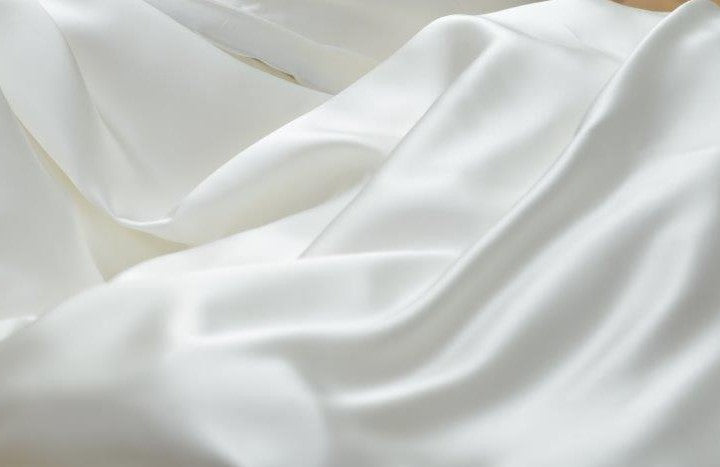


Real silk cannot be identified solely by its sheen, price, or feel. Modern textiles made from other fibers can also be very smooth and shiny. Those who want to reliably assess silk should therefore consider several characteristics together.
The short answer: When purchasing, clear material labeling such as "100% silk" or "100% mulberry silk" is the most important point of reference. Information regarding the type of silk, momme, and workmanship provides additional details. By contrast, sheen, hand-feel, price, or a burn test alone are not sufficient to reliably determine real or high-quality silk.
1. Pay attention to the material information
The most important starting point when buying a silk product is the material label. It should clearly state which fibers the product consists of.
Typical specifications are, for example:
- 100% silk
- 100% mulberry silk
- Silk in combination with other fibers
For blended fabrics, the proportion of the individual fibers in the product should also be stated.
Terms such as "silky," "silk touch," or similar phrases, however, do not automatically mean that a fabric is actually made of silk.
2. Is satin the same as silk?
No. Silk and satin refer to two different things.
Silk is a fiber or a fiber material. Satin, on the other hand, describes a weave that can create an especially smooth surface.
Satin can therefore be manufactured from different fibers, for example from:
- silk,
- cotton,
- polyester, or
- other fiber materials.
A product labeled "satin" is therefore not automatically a silk product. The actual material composition is the decisive factor.
3. Can you recognize real silk by its sheen?
Sheen can be a characteristic feature of certain silk fabrics, but it is not a reliable proof of authenticity.
Depending on the weave and processing, silk can have varying degrees of luster. At the same time, fabrics made from other fibers can also have a very shiny surface.
The visual impression can therefore be an indication, but it should never be used on its own for assessment.
4. Can you recognize real silk by its feel?
High-quality silk fabrics can feel very smooth, fine, and supple. However, the feel also depends on the weave, fabric weight, and workmanship.
Furthermore, modern fabrics made from other fibers can also be produced to be very soft and smooth.
The "hand" of a fabric can therefore help in the assessment, but it does not replace clear material labeling.
5. What does momme mean for real silk?
Momme is a traditional unit for the fabric weight of silk. You will often find specifications such as 19, 22, or 25 momme.
A momme number, however, proves neither the authenticity nor automatically the quality of a silk fabric.
A higher momme value initially means that a comparable fabric has more weight per area. The overall quality also depends on the raw material, yarn, weaving, dyeing, and workmanship.
We explain how to interpret 19, 22, and 25 momme as well as the frequently used 6A designation in detail in our guide "What does momme mean for silk? Quality, 6A, and standards explained".
6. What does mulberry silk mean?
Mulberry silk comes from the domesticated mulberry silkworm. Its fine and relatively uniform filaments are particularly well-suited for smooth and fine silk fabrics.
However, mulberry silk is not the only type of real silk. Tussah or wild silk is also real silk and is used for various textiles and bedding.
We explain the differences in the guide "Mulberry silk or wild silk? Differences and usage explained".
7. Is 6A proof of high-quality silk?
The term 6A is frequently mentioned for products made from mulberry silk. However, it should not be understood as the sole quality assessment of a finished silk product.
6A refers to a classification of raw silk. Between raw silk and a finished pillowcase or duvet cover, there are further processing steps such as yarn production, weaving, dyeing, cutting, and sewing.
The quality of a finished product therefore cannot be derived solely from the 6A designation.
8. Can you recognize real silk with a burn test?
The so-called burn test is frequently cited as a method for distinguishing textile fibers. The behavior of a small fiber sample when burning can provide clues to the type of fiber.
For consumers, however, this method is only useful to a limited extent: it damages the material, carries a fire risk, and can be difficult to interpret with blended fabrics or treated fabrics.
For a finished pillowcase or duvet cover, one should therefore not simply cut off or set fire to the fabric. For a purchasing decision, transparent material information is much more useful.
9. Does a high price automatically mean high-quality silk?
No. A higher price can be the result of material quantity, production, processing, brand, distribution, or other factors.
Price alone therefore proves neither that a product is made of real silk nor that it has been crafted to a high quality.
Conversely, a noticeably low price for supposedly high-quality silk products should be a reason to check the material information and product description more closely.
10. How can you recognize high-quality silk products?
When assessing a finished silk product, several factors should be considered together:
- clear and understandable material information,
- specification of the silk type used,
- for silk fabrics, a clear statement of the fabric weight,
- uniform fabric surface,
- neat seams and workmanship,
- appropriate care instructions, and
- transparent product information.
No single piece of information replaces the assessment of the product as a whole.
How can you recognize real silk bedding?
For silk bedding, one should first check whether the duvet cover itself is actually made of silk. The material label should clearly indicate this.
Additional information such as mulberry silk and momme helps to classify the silk fabric used more precisely.
You can find our corresponding duvet covers under silk bedding made from mulberry silk.
How can you recognize a real silk pillowcase?
For a silk pillowcase, too, the material composition is more important than terms such as "satin," "shiny," or "silky."
Anyone looking for a silk cover should look for a clear label such as "100% silk" or "100% mulberry silk" and take into account additional information about the fabric weight and workmanship.
You can find our various sizes and colors under silk pillowcases made from mulberry silk.
Conclusion: Real silk cannot be recognized by a single characteristic
A clear material label is the most important point of reference when purchasing real silk. Sheen, feel, price, or momme alone are not sufficient.
To assess quality, one should additionally consider the type of silk, fabric weight, weaving, dyeing, and workmanship.
It is also particularly important to distinguish between different terms: silk refers to the fiber, satin to a weave, momme to the fabric weight, and 6A to a classification at the raw silk level.
Frequently asked questions about identifying real silk
Is shiny fabric always silk?
No. Other fibers can also be processed into shiny fabrics. Sheen alone is therefore no proof of real silk.
Is satin real silk?
Not necessarily. Satin refers to a weave and can consist of silk, cotton, polyester, or other fibers. The material information is the deciding factor.
Is mulberry silk real silk?
Yes. Mulberry silk is a natural type of silk. It comes from the domesticated mulberry silkworm.
Is wild silk real silk?
Yes. Tussah or wild silk is also real silk, but differs from mulberry silk in its origin and fiber structure.
Does 22 momme prove that a fabric consists of real silk?
No. Momme is a weight specification for silk fabrics. The number alone is not a proof of authenticity and not a complete quality assessment.
Can you test real silk at home?
Visuals and feel can provide clues, but they are not definitive. A burn test is not recommended for finished products due to the damage and fire risk. When purchasing, one should therefore primarily pay attention to transparent material labeling.