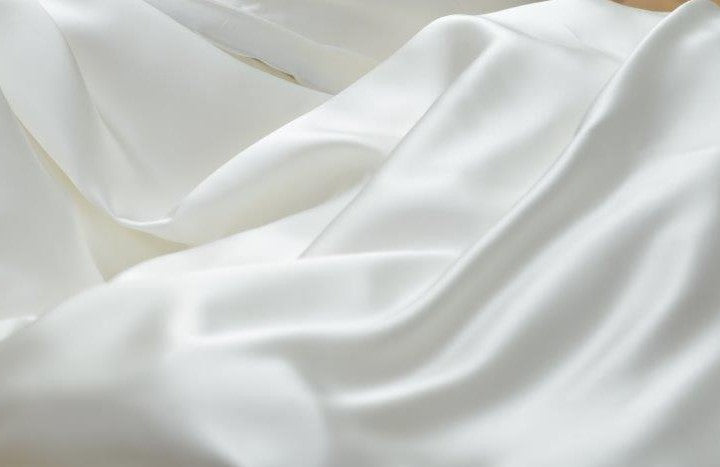


Mulberry silk and wild silk are natural types of silk, but they differ in their origin, fiber structure, and processing. These differences influence which textiles and bedding they are particularly suitable for.
The short answer: Mulberry silk possesses particularly fine and uniform filaments and is therefore very well suited for smooth silk fabrics like bed linen and pillowcases. Wild silk—such as Tussah silk—has a different fiber structure and is used for things including duvet fillings and other bedding. Which silk is better suited therefore depends on the specific product.
What is Mulberry silk?
Mulberry silk comes from the domesticated mulberry silkworm. The silkworms are fed with leaves from the mulberry tree and then form their cocoons.
The resulting silk filaments are fine and relatively uniform. This allows mulberry silk to be processed into very smooth and fine fabrics.
These properties make mulberry silk particularly suitable for products where the fabric surface comes into direct contact with skin and hair, such as silk bed linen and silk pillowcases.
What is wild silk?
Wild silk refers to types of silk that come from silkworm species that live in the wild or are less domesticated. A well-known form is Tussah silk.
The fibers differ from those of classic mulberry silk in, among other things, structure and uniformity. As a result, materials made from them often have a different character than particularly smooth mulberry silk fabrics.
Wild silk can be used, for example, for duvet fillings, pillows, or mattress toppers where the focus is not on the shiny and particularly smooth surface of a fine silk fabric.
What is the difference between mulberry silk and Tussah silk?
| Feature | Mulberry silk | Tussah/Wild silk |
|---|---|---|
| Origin | domesticated mulberry silkworm | wild or less domesticated silkworm species |
| Diet | primarily mulberry leaves | depends on the respective silkworm species |
| Fiber structure | fine and relatively uniform | differently structured and less uniform |
| Typical use | fine silk fabrics, bed linen, pillowcases | including duvet fillings, pillows, and toppers |
Is mulberry silk higher quality than wild silk?
A general classification into "high quality" and "low quality" is not meaningful. Mulberry silk and wild silk possess different properties and can therefore be suitable for different products.
For a particularly smooth silk pillowcase, the fine and uniform structure of mulberry silk is an advantage. For a duvet filling or a topper, however, other properties and the construction of the entire product are the focus.
The quality of a finished silk product therefore depends not only on the name of the silk type, but also on material selection, processing, and intended use.
Which silk is suitable for silk bed linen?
Mulberry silk is frequently used for bed linen and pillowcases. Its fine filaments enable the production of smooth, supple silk fabrics.
With bed linen, the fabric lies directly against the skin. In addition to the silk type, fabric weight, weave, dyeing, and processing also play an important role.
You can find our corresponding products under Mulberry silk bed linen and Mulberry silk pillowcases.
Which silk is suitable for a silk duvet?
For a silk duvet, a distinction must be made between filling and outer cover. The silk is located in the filling, while the outer cover can consist of cotton sateen, lyocell, or silk satin, depending on the model.
Different types of silk can be used for silk duvets. In addition to the silk used, the filling quantity, filling structure, and processing are also decisive.
We show how multi-layer duvet fillings are created from silk fibers in our guide "How is a silk duvet made?".
You can find our summer, all-season, and winter models under Silk duvets with silk filling.
Which silk is used for pillows and toppers?
Silk can also be used as a filling material for pillows and toppers. Here, the type of silk used must always be evaluated based on the specific product.
ORIGNEE®, for example, uses mulberry silk, Tussah silk, or combinations of different materials depending on the product. The material composition is therefore stated on the respective product page.
What does momme mean for mulberry silk?
Mulberry silk and momme describe two different things. Mulberry silk refers to the type of silk, momme to the weight of a silk fabric.
A fabric made of mulberry silk can, for example, have 19, 22, or 25 momme. A higher momme count means more fabric weight, but not automatically higher quality.
We explain how to interpret momme and the frequently used 6A designation in our guide "What does momme mean for silk? Quality, 6A, and standards explained".
Is wild silk the same as raw silk?
No. The terms do not describe the same thing.
Wild silk refers to silk from certain silkworm species or their origin. Raw silk, on the other hand, describes a stage of silk processing.
Therefore, it should not automatically be assumed from the designation "raw silk" that it is wild silk.
How can you tell which silk a product contains?
The first decisive factor is the product's material labeling. Terms such as "silk," "mulberry silk," or details about the composition should be stated as clearly and comprehensibly as possible.
Shine, feel, or price, on the other hand, are not sufficient to reliably determine a specific type of silk.
We explain what else to look out for when buying in our guide "How to recognize real silk? Features, material details, and quality".
Mulberry silk or wild silk – which is better?
That depends on the intended use. For particularly smooth silk fabrics that come into direct contact with skin and hair, mulberry silk is very suitable. Wild silk such as Tussah silk, however, can be sensibly used for certain fillings and bedding.
Instead of searching exclusively for the supposedly "best" type of silk, one should therefore check which silk is used, where it is used in the product, and how the entire product is processed.
Frequently asked questions about mulberry silk and wild silk
Is Tussah silk real silk?
Yes. Tussah silk is a form of wild silk and therefore real silk. However, it differs in origin and fiber structure from classic mulberry silk.
Is mulberry silk real silk?
Yes. Mulberry silk is obtained from the cocoons of the mulberry silkworm and is one of the natural types of silk.
Is mulberry silk always 6A?
No. "Mulberry silk" refers to the type of silk or origin, while 6A denotes a classification of raw silk. The two terms are therefore not synonymous.
Is 22 momme mulberry silk better than 19 momme?
Not automatically. 22 momme has a higher fabric weight than 19 momme. However, raw material, yarn, weaving, dyeing, and processing are also relevant for the quality of a finished silk fabric.
Can wild silk be used for duvets?
Yes. Wild silk or Tussah silk can be used as a filling material for duvets and other bedding. The concrete material composition and the construction of the product are decisive.