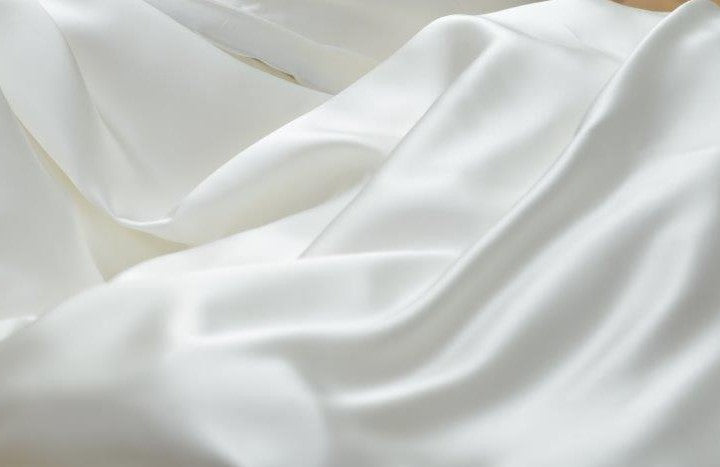


As a protein fiber, similar to hair, silk is sensitive to heat, soaking in water, strong sunlight, and heavy mechanical stress. Keep your silk products away from aggressive chemicals. Caring for silk is similar to hair care:
- Soak the silk briefly (max. 5 minutes) in cold to lukewarm (max. 30 degrees) water. It is best to use a special silk shampoo.
- Gently swish the fabric back and forth. Localized stains can be carefully hand-washed. Then rinse with cold water.
- Roll the silk in a dry towel and then let it dry flat on the drying rack.
- Ironing: Silk should always be ironed inside out at a low temperature. It is best to place a cloth between the iron and the silk.
Alternatively, silk can also be machine-washed on a gentle cycle.
To maintain the silky sheen, add 2 tablespoons of vinegar essence to the fabric softener compartment or to the water for hand washing with each wash cycle.
If you follow these tips, you will enjoy your silk products for a long time.
Instructions for caring for silk duvets and silk pillows
Before first use
For hygienic reasons, silk duvets and pillows are hermetically sealed. Before first use, we recommend ventilating the duvet or pillow thoroughly and shaking it repeatedly. After some time (approx. 2 to 3 hours), the duvet or pillow will regain its natural fullness.
You may notice a subtle sour smell on your freshly unpacked silk duvet or pillow. This is completely normal! It comes from sericin, the natural protective substance of the silk cocoon. The smell will subside over time and eventually disappear completely. Sericin is a soluble protein and has a positive effect on the skin.
Care
Due to its good self-cleaning function, it is sufficient to regularly shake out the duvet or pillow to keep it airy and dry. Localized stains can be carefully hand-washed with silk detergent only at a maximum of 30 degrees.
Storage
If the duvet or pillow is not used for a longer period, it should be well ventilated again and completely dry before storage. Make sure that the duvet or pillow has enough space and is not compressed too much.
Please note with silk duvets with Lyocell or silk covers
If the silk duvet is covered with a fine cover such as Lyocell or silk, it can sometimes happen that individual silk fibers penetrate through the meshes of the cover.
This is because mulberry silk fibers are extremely thin and can sometimes push through the meshes of the cover. It does not have to happen, but it could. With a robust fabric like a cotton cover, this does not happen because cotton is relatively heavy and presses down on the silk fibers. But then the duvet is also nowhere near as beautiful as with a silk cover...
In this case, you can simply cut off the protruding fiber, and the silk duvet will retain its usual beauty. Over time, this happens less and less, or not at all, as the silk filling becomes "one" over time.
Of course, you can also send the duvet to us, and we will cut off the protruding fibers for you.